
Textiles, Furniture & Vessels


Beautiful Textiles
We currently carry Mud, Kuba and Kente textiles. Whether for the populace or only for royalty (and their cohorts)- cloths of beauty! Westerners consider them as artworks. They come in different sizes and colors, with classic sign/symbols (ethnographic signs and symbols used by old Africans to transmit information ( check out, Tracing Memory - a Glossary of Graphic Signs and Symbols in African Art and Culture by Clementine M. Faik-Nzuji) - on our Ashione-yan page. While on the page, scroll all the way down).
They come in many grades (grade A, grade B, grade C, grade D and so on). Naturally the upper and middle classes would prefer grade As - the finest pieces there are- since they can afford them!
We carry only Grade As.
Mud Cloth
Mud cloth is the cloth of the people, as opposed to those other cloths like the Ghanaian Kente cloth or the Akwete of Nigeria, that were made for royalty and leaders of a higher status. In Mali, the ordinary person can go to the market and buy this cloth, which they call burgurlon, that is if one can afford it.
In current times, people all over the world have found different uses for them. Some of the known uses are, wall hangings, back drops for art work displays, scarves, table cloths, pillow coverings, covering for unseemly portions of a room, exotic role playing, area floor covering , a head wrap (see our dashing Asian woman on this page, as well as the Moments and Memories page), in fashionable assemblages, framed and displayed as art works, and of course, as wonderful gifts.
However, the most important usage would be yours! Below are our selection to help you towards fulfilling your own use!
Hover/Click each product for more details (size etc.)


Mud Cloth


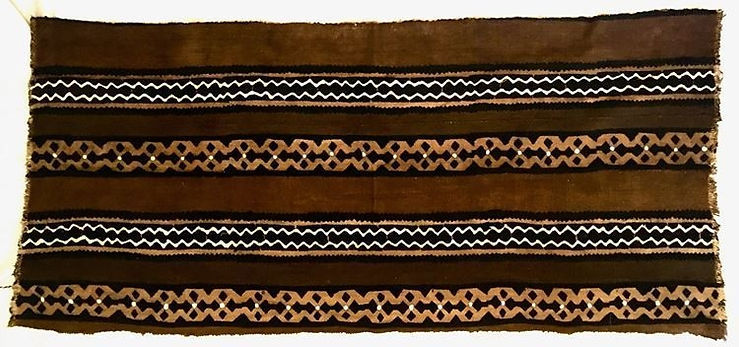


Kuba Cloth

Kuba cloth was made by the Kuba people of the Congo. It was constructed from 100% grass (raffia). Many people become quite incredulous when informed of this fact.
Using a complex ancient technique, the Kuba people weaved, dyed and embroidered stunning pieces that have now seemingly captured the fancy of the entire world! The cloths have been seen in museums and fine high -end elegant galleries. In our much watched sitcom, Frazier (we so love Frazier perhaps because of the main characters' affinity for African art!), Niles had two of similar below Kuba cloths framed and hung in his (Psychiatry) office. And those two, Frazier and Niles and the rest of the team, seemed to know something about high culture and sophistication!
Kuba cloths have also featured as other art works for the wall, used for fine throws, fine pillows cases, table top center pieces, high end scarves, and so on. In fact, there is no end to their usefulness and practicality. Perhaps you too can invent your own uses.


Kente Cloth
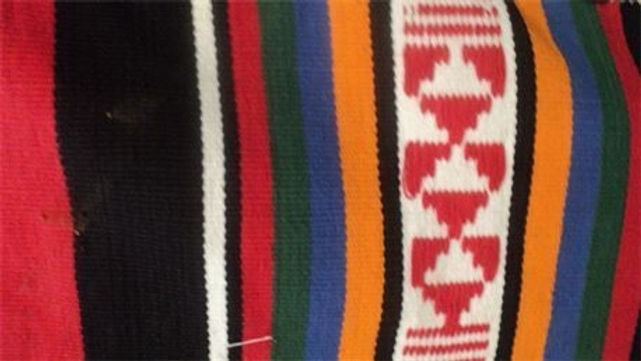
Kente cloth is one of the better known African textiles. Using symbols that informed of the social, moral, ethical, and religious values of the people, the Ewe and Ashanti peoples weaved these glorious cloths. These are stories told on textiles, not on a tablet!
The weavers were famous in their day, and had their own particular signature patterns. In fact, oral history offers us many myths around Kente cloth weaving. One such myth was that the weaver so valued his tools (of the trade), and they were so sacred to him, that were he to make plans to travel, he would first dispose of his weaving sticks in a river, to prevent another weaver from obtaining them.
In the olden days, Kente cloth was only worn by royalty and their cohorts. But it seems like now a days everyone wants to treat themselves royally and be able to obtain some Kente strips or cloths.

In Ghana, indigenes who may not be able to afford a whole cloth, and even when they could, would frame a family heirloom (as to your right) with a Kente strip/s. In other words, they would use the strip/s as a fine frame. They also hung them on the wall as show pieces, because Kente cloth is truly valued.
We sell only authentic Kente strips weaved in Ghana by Ghanaian or Ewe weavers.
Please note, these show what seems to be age related visages-holes, tears, extra tassels, etc. They may be what makes them charming and attractive.


Handwoven Tuareg Textile
Furniture
African furniture pieces are not just practical, decorative and beautiful to look at, they many times serve important ceremonial purposes, as well. They may be hand carved for kings or queens (royalty) as thrones, or for leaders of high status. The size of the furniture (stool) did not always determine the status of the owner. A throne could come in the size of a small stool, if it were carved for royalty to sit on during a ceremony. A stool could also be of the kind found in your grandma's home, were you African. But whether carved for royalty or for the average people, African furniture seem to have beautifully transcended time, place and cultures.


They seem to direct one's attention to them, while at the same time blending in well within environments. We remember so well to this day a stool we had delivered to a home on 5th Avenue where it crossed the West Village in Manhattan, New York. It was to a wonderful apartment with wooden floors that were so polished that they shone. We put the stool down where she motioned and were amazed that one could not tell that the stool had just been brought in! It was a wonderful blending in, but the addition of the stool still seemed to add some "magic" to that apartment!

Fantastic Nupe stool with a multitude of legs. The carver's choice of colors makes for a dazzling aesthetic look. Color is good! See model below sitting on this stool!!
Please Call for the Price. Thank You.


From Makonde thrones, Kuba chairs, Kenyan or Congolese headrests, and to Nupe stools, we shop for furniture we believe are wonderful and would bring tastefulness and elegance to your home or office. They also make amazing and memorable gifts.
Below are our fantastic selection.


Vessels


Els. 107
Fantastic Burkina Faso Terracotta Vessel
Hollowed and rounded and ethnographically decorated with recurring sign/symbol(ed) motifs of animals and a man. Wonderful brown/black patina. 16"high, including legs, and 37" in diameter.
Please Call us for the Price and your pick up arrangements. Thank you.


Els. 108
Awesome Mangbetu Cephalomorphic Ceramic Vessel
This vessel is on the heavy side. Special arrangements have to be made for pick up.
Please Call us for the Price and your pick up arrangements. Thank You.


Els. 109
Fantastic terracotta vessel.
Burkina Faso. Hollowed and rounded, with a wonderful black/brown patina, probably signifying where it was held to be moved about, as there were no handles. Its height is 23" and the diameter is 56". It comes with the support element at the bottom, but without the hanging art objects! You may inquire about any of the hanging objects to see if any is still available. Ethnographic sign/ symbols etched on the vessel- ancient stories told on a vessel, instead of a tablet!
The price break gives a huge incentive to buy now!
Enjoy!
Please Call us for the Price and your arrangements for pick up!
Previous Text
Africans surround themselves with beautiful and colorful textiles, furniture and vessels. The idea behind this is that Africans used color and beauty to attract the gods. Powerful animal motifs, detailing, size, and ancestral sign-symbols are sometimes used to delineate those meant for royalty or other persons of high status.

Mud Cloth
Mud cloth is the cloth of the people (as opposed to those cloths, like the Ghanaian Kente cloth, that were made for royalty and leaders of high status). In Mali, the ordinary person can go to the market and buy this cloth (which they call Burgurlon), that is if one can afford it.
This stunning cloth is hand spurned from 100% cotton and dyed through an indigenous process which has been handed down through tradition. The dye is obtained through a natural mixture of mud, grass and bark (the percentage for each constituent is also handed down and may be different for each weaver) and looks muddy, hence the name "mud cloth" given it by westerners.
It comes in many grades (grade A, grade B, grade C, grade D and so on). Naturally, the upper and middle classes would prefer grade As- the finest pieces!- since they can afford these.


We carry only Grade As.
There are usually dye overruns and other natural "imperfections". These may add to the cloths beauty and authenticity and many Africans prefer these , because they demonstrate tradition.
The Fashion Institute of Technology, New York (www3.fitnyc.edu), did an expose on mud cloths in the 1990s. Perhaps they still have a film on this topic, that one can borrow . Mud cloth is by itself a piece of art that can warm up any home or can be given as a beautiful gift. It is desired the world over! The designs on the textiles are quite enchanting! If one should desire to find out the meanings behind some of the designs, one should check out, Tracing Memory- a Glossary of Graphic Signs and Symbols in African Art and Culture by Clementine M.Faik-Nzuji (see Ashione-yan)a